
How Modern Shopfronts Can Improve Customer Footfall
A shopfront has only a short time to earn attention. As people walk or drive past, they decide whether they can see what a business offers, whether the premises feel relevant to them and whether entering looks straightforward. That is why how modern shopfronts can improve customer footfall is not simply a question of appearance; it is a practical consideration for any retail business competing for attention on a busy street.
For London businesses, a frontage upgrade may help create a clearer, more inviting first impression and increase the opportunity for passing trade to become a visit. It cannot guarantee footfall or sales: location, pedestrian traffic, the retail offer, pricing, competition and customer demand still matter. However, as a shopfront installation provider, Direct Shopfront helps business and property decision-makers consider the physical details that make a commercial frontage easier to notice, understand and use. Our London shopfront services are relevant where a new, replacement or refurbished frontage needs to balance presentation with day-to-day performance.
Why the shopfront matters to customer footfall
The shopfront is the point where a business meets the street. Before a customer assesses stock, service or price, they have already formed an impression from the fascia, glazing, entrance, display and overall condition of the frontage. A tired, cluttered or difficult-to-read exterior can make a capable business easier to overlook. By contrast, a coherent modern retail shopfront design can make the offer more legible and the premises feel more approachable.
This is especially significant where customers have choices nearby. On a high street, pedestrians often scan several frontages at once. Strong kerb appeal does not mean using the largest sign, the brightest lighting or the most elaborate finish. It means making the right information visible in a way that suits the business: what is sold, who it is for and where the entrance is.
Modern shopfronts and customer footfall are linked through a sequence of small decisions:
- Recognition: passers-by can identify the business and its category quickly.
- Interest: the window, display or presentation gives a reason to pause.
- Reassurance: the premises appear cared for, safe and professionally operated.
- Access: the route from pavement to entrance is clear and practical.
- Experience: the frontage sets realistic expectations for the visit inside.
A shopfront does not need to appeal equally to everyone. It should be designed around the likely customer and the way they encounter the premises. A specialist retailer may benefit from calm, precise presentation, while a convenience-led business may need instant product visibility and a clearly identifiable entrance. In each case, customer-focused shopfront design makes it easier for the right person to recognise the value of stopping.
How modern shopfront design attracts attention
Attention on the street is earned through clarity rather than excess. Proportion, contrast, sightlines and well-maintained materials all contribute to visual appeal. A modern frontage can remove distractions that obscure the business, while still retaining a character that is appropriate for the building and the brand.
At a practical level, assess the shopfront from the customer’s likely approach. Can someone see the name and category from a distance? Is the front visible around parked vehicles, street furniture or neighbouring signs? Does the composition still make sense to a pedestrian walking from either direction? These questions are more useful than choosing a design based only on an isolated elevation or a close-up sample.
Make the offer visible from the street
Clear glazing can improve retail visibility by allowing people to see into a shop, view selected products or understand the atmosphere before committing to enter. Natural light may also make displays feel more open and reduce the visual barrier between pavement and premises. For suitable businesses, glass shopfront solutions in London can provide this openness while allowing the specification to account for security, safety and the practical needs of the unit.
Transparency works best when the view beyond the glass is purposeful. A crowded window, unplanned storage or excessive posters can undo the benefit of modern glazing. Instead, use the window as a simple visual conversation: feature a focused range, communicate the type of business and leave enough open space for the interior to be understood. This can be particularly valuable for premises relying on spontaneous interest from passing pedestrians.
Consider sightlines at different heights as well. A display aimed only at someone standing directly in front of the window may miss customers approaching from further away. Equally, completely exposing an interior is not always right. Some businesses need privacy, controlled light or a more curated display. The goal is not maximum transparency; it is a frontage that gives customers enough confidence and curiosity to take the next step.
Street character also affects what is likely to stand out effectively. A frontage should not copy its neighbours, but it should respond to the pace, width and visual density of its setting. Businesses considering shopfront decisions in Islington, for example, may need to assess how their sign, glazing and window display will read within an established retail environment rather than in isolation.
Use signage, lighting and presentation consistently
Retail signage should identify the business without competing with every other element of the elevation. The typeface, scale, placement and illumination need to support quick recognition. If a customer cannot work out what the premises are until they are directly outside, the shop may be losing useful moments of attention from people moving through the area.
Lighting extends this clarity when daylight fades. It can draw attention to a fascia, make the entrance more apparent and help a display remain visible in the evening. Poorly positioned or overly harsh lighting, however, can create glare on glazing, wash out products or make the frontage feel uncomfortable. A restrained scheme that supports the architecture and the display is often more effective than lighting every surface.
Consistency matters as much as individual features. Signage, window graphics, paint or cladding finishes, handles, lighting and display fixtures should communicate the same level of care. This does not require a costly redesign of every element, but mismatched additions can weaken brand presentation and make a retail premises look temporary. Retail shopfront improvements should make the customer journey clearer, not add more visual noise.

WHY DIRECT SHOPFRONT
BUILT WITH PURPOSE.
FINISHED WITH
PRECISION.
Bespoke solutions. Durable materials. Professional installation. One team to manage your project from the first survey through to the final finish — with repairs and aftercare when you need them.
Create an entrance that feels welcoming and accessible
A person may notice a shop and still decide not to enter if the doorway feels unclear, cramped or awkward to use. Entrance design turns interest into action. The threshold should be easy to locate, visually distinct from the display and usable for the broadest practical range of visitors.
Start with the pedestrian’s route. The doorway should be apparent from the pavement, and opening the door should not require unnecessary effort or uncertainty. Clear glass doors can help show that the premises are open and active, while appropriate manifestations and handles can make the door itself easy to identify. The exact approach will depend on the layout, building fabric and operational requirements, but the customer should not have to guess where to go.
Accessibility is both a customer experience issue and a premises consideration. Step-free access, threshold details, door widths, door operation and the space immediately inside the entrance may need careful review. Requirements can vary, so building regulations and accessibility matters should be checked for the individual property rather than assumed from a general design idea. Even where physical constraints limit changes, a considered entrance can reduce avoidable friction for customers with pushchairs, mobility aids, shopping bags or limited dexterity.
The entrance also signals what the visit may feel like. An exposed, well-lit threshold can feel welcoming, but it should remain comfortable in changing weather and practical for staff to manage. Recesses, canopies, door closers and flooring transitions should be planned as part of the frontage rather than left as afterthoughts. A shopfront that attracts customers should offer a simple, confident transition from street to store.
Balance openness with security and practicality
Visibility must be balanced with the realities of operating a retail unit. Glass, open displays and wide entrances can support an inviting appearance, but they need an appropriate approach to security, cleaning, weather resistance and closing procedures. Security measures that are imposed without considering the daytime frontage can make a business look shut even when it is open.
Discuss the full operating cycle before choosing a specification: opening, trading, cleaning, deliveries, closing and overnight security. For example, a display may need to be easy to refresh, doors may need to handle frequent use and any security solution should work with rather than dominate the shopfront design. The best option is rarely a purely visual one; it is the one that staff can use consistently while maintaining a positive customer-facing appearance.
| Frontage decision | Potential benefit for visits | Practical point to assess |
|---|---|---|
| Clear glazing | Helps people see the offer and activity inside | Display discipline, privacy, glare and security specification |
| Defined entrance | Reduces uncertainty about where and how to enter | Threshold, door operation, access and weather exposure |
| Illuminated sign or display | Supports visibility at lower-light trading times | Glare, energy use, maintenance and local controls |
| Integrated security approach | Can provide reassurance without an overly closed appearance | Closing routine, visual impact and compatibility with the frontage |
Choose materials and finishes for a busy London setting
Material choice affects how a shopfront performs long after the initial visual impact. Shopfront materials influence durability, maintenance demands, weather resistance, security options and the precision of the final finish. They also affect whether a frontage continues to look cared for after exposure to daily use, rain, pollution and the knocks that can occur on active streets.
Aluminium, steel, timber and glazing can all have a place in a modern commercial frontage. There is no universal best material because the appropriate choice depends on the building, the brand, the desired appearance, the span and configuration of the opening, security needs and the level of maintenance the business can realistically sustain. A finish that looks impressive at handover but is difficult to keep clean or repair may not support a strong first impression for long.
For a closer look at durability and suitability considerations, our guide to shopfront materials for busy London high streets explains the factors worth comparing before a material is selected. In footfall terms, the important point is continuity: a clean, sound and well-maintained frontage supports confidence, while damaged panels, faded finishes or poorly functioning doors can distract from the retail offer.
Maintenance should be part of the initial decision, not a separate issue for later. Ask how surfaces will be cleaned, whether replacement components will be practical, where water can collect, how finishes will age and how display changes may affect the frontage. This makes it easier to protect visual appeal without creating unnecessary disruption to normal trading.
Consider the street, building and local context
A modern shopfront does not have to look identical to every other contemporary frontage. Good design responds to the proportions and character of the building as well as the business itself. A solution that feels at home on one commercial street may appear out of scale or visually disconnected on another.
This is not only an aesthetic concern. A frontage that complements its surroundings can contribute to a more coherent, appealing street experience, whereas an intrusive design may draw the wrong sort of attention. Westminster’s shopfront design guidance similarly highlights the value of maintaining, refurbishing and replacing shopfronts in ways that respect local character and contribute positively to the commercial environment.
Planning policies, conservation considerations, landlord approvals and other local guidance may be relevant depending on the premises and proposed work. These should be checked early, particularly where signage, illumination, external alterations or a sensitive building context are involved. A business looking at its options in Westminster should treat the surrounding building and street as an input to the design brief, not an obstacle to address after a preferred design has been chosen.
Matching context does not mean losing brand identity. It means translating that identity through appropriate proportions, materials, colour, signage and detailing. The result can still be distinctive, while making a positive contribution to the wider high street and presenting the business as established rather than out of place.
Match the shopfront to the customer and business
The most successful shopfront design for attracting customers starts with a clear understanding of the intended visitor. A premium service, a family-focused retailer, a food business and a specialist showroom may all need different degrees of openness, product visibility, signage and display. Selecting features because they are fashionable, rather than because they help the customer understand the business, can lead to an expensive frontage with limited practical value.
Define the role of the frontage before deciding on the finish. Is it primarily there to showcase products? Build trust for a service-led business? Make a compact entrance easier to find? Refresh an ageing premises so it better reflects the offer inside? The answer should guide the balance between glass, solid panels, signage, displays and lighting.
Prioritise the improvements most likely to help
A full replacement is not always the first or only answer. In some cases, shopfront refurbishment for retail businesses may focus on the features that most affect street presence: updating a fascia, improving glazing, resolving a poorly defined entrance, repairing worn finishes or creating a more focused display area. In other situations, an older frontage may have operational, condition or design limitations that make a new installation the more sensible route.
Use a simple decision process to identify the highest-value improvements:
- Observe the approach: view the premises from both directions of travel and at different times of day. Note what is visible first and what is missed.
- Identify the customer message: decide what a passer-by should understand in a few seconds about the business and its offer.
- Find barriers to entry: look for obscured doors, cluttered windows, poor lighting, worn finishes or access issues that may make a visit less likely.
- Set practical constraints: include budget, trading disruption, maintenance capacity, security, landlord requirements and any approvals that may need attention.
- Choose a coordinated scope: prioritise changes that work together rather than adding disconnected visual features over time.
For further decision support, see our guidance on choosing the right shopfront for a London retail business. It can help frame the conversation around the premises, the customer and the operational needs of the business, rather than treating materials or style as isolated choices.
When professional shopfront installation can help
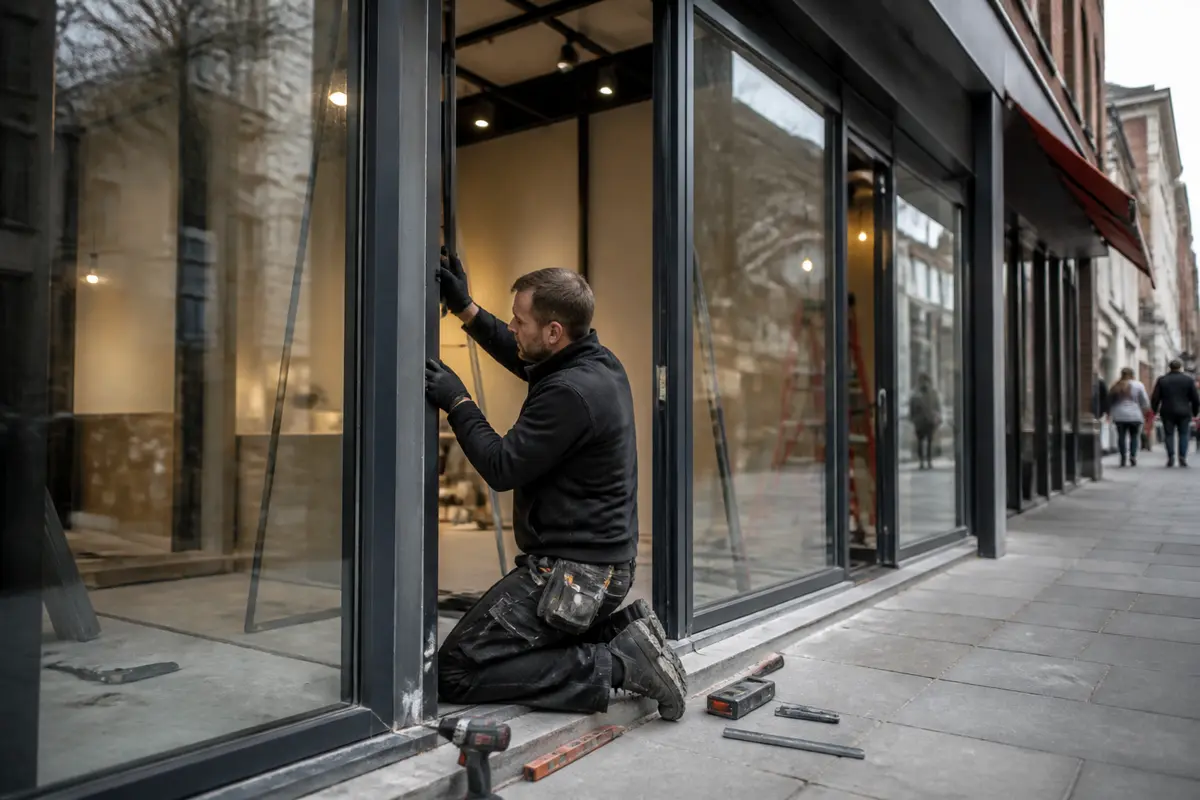
Professional input is particularly useful when a business is changing the layout of its frontage, replacing doors or glazing, introducing new signage, addressing access concerns or coordinating several elements into one coherent elevation. These decisions can affect not only appearance, but also measurements, safe operation, weather performance, security, building interfaces and the practical sequencing of work.
A considered installation process helps turn a general ambition to increase retail footfall with a shopfront into a buildable brief. It creates an opportunity to assess the existing opening, the condition of the frontage, the desired customer experience and the constraints that could affect the finished result. This is preferable to choosing components separately and discovering late in the process that they do not work together.
When assessing providers or shaping a brief, reviewing relevant shopfront installation projects can be useful for understanding how different frontage elements are combined. Examples should be used to discuss design principles and suitability, not as a promise that a similar result will be right for every property.
A practical checklist before upgrading a shopfront
- What should a passer-by notice and understand before reaching the door?
- Does the existing frontage make the business look open, maintained and relevant to its audience?
- Which aspects of visibility need improvement: fascia, glazing, window display, lighting or the entrance?
- How will the chosen materials withstand regular use, cleaning and weather exposure?
- What level of transparency is appropriate for product display, privacy and security?
- Can the entrance support comfortable access for the customers likely to use the premises?
- Are planning considerations, building regulations, landlord consent or local design guidance likely to need checking?
- How can work be planned to reduce unnecessary interruption to trading?
Direct Shopfront can help businesses consider these questions in the context of a proposed installation or upgrade. For a broader service discussion, explore our shopfront installation options across London and focus the brief on the practical changes most likely to improve visibility, welcome and everyday performance.
Conclusion: use the frontage to support more visits
A modern shopfront can improve the opportunity for customer footfall by making a retail premises easier to notice, easier to understand and more comfortable to enter. Clear sightlines, focused displays, considered signage, appropriate lighting and a practical entrance all help reduce the gap between a passer-by seeing the business and choosing to visit.
The strongest results come from treating the frontage as one connected customer experience rather than a collection of separate upgrades. Visual impact should work alongside durability, maintenance, access, security, weather resistance and the character of the building. A bold design that is difficult to operate, or a highly durable frontage that does not communicate the offer, may not meet the business’s real needs.
For London retail and commercial property decision-makers, the sensible next step is to assess the existing frontage through the customer’s eyes, identify the clearest barriers to attention or entry and develop an installation scope that addresses them coherently. Direct Shopfront can provide relevant shopfront installation support where a business is ready to translate those priorities into a modern, practical commercial frontage.
READY TO TRANSFORM YOUR SHOPFRONT?
Design - Installation - Materials
Tell us about your project and our team will help you plan the right design, materials and installation.
Request Quote
Free Estimates