
Why Experience Matters When Choosing Shopfront Installers
Why Experience Matters When Choosing Shopfront Installers – Direct Shopfront offers guidance to help you plan your shopfront installation with confidence.
Choosing an installer without understanding the value of relevant experience can leave important questions about the premises, scope and installation planning unanswered until late in the process. A shopfront is not simply selected from a catalogue and fitted in isolation: the existing frontage, access arrangements, materials and trading needs can all affect what should be discussed before work starts.
For London business owners, retail managers and landlords, experienced shopfront installers can bring a more informed approach to those early conversations. Direct Shopfront operates in the shopfront installation sector, where decisions should be based on the actual site and requirements rather than broad assumptions. Whether you are considering shopfront installation options across London or replacing a tired frontage, the useful question is not simply how long a provider has traded, but whether its experience is relevant to your proposed work.
How experience affects the installation from the first assessment
The earliest assessment often shapes the quality of the decisions that follow. Relevant shopfront installation experience may help an installer ask more useful questions about the opening, surrounding structure, preferred appearance, access and the practical order in which work could be considered. It does not mean every issue can be predicted before work begins, but it can reduce the risk of relying on an incomplete picture.
For the customer, this is important because the quotation and proposed scope should stem from a real discussion about the premises. A provider that seeks clarity early gives you a better basis for comparing proposals and deciding what still needs confirming.
Experience helps identify project-specific requirements early
An existing frontage may have features that are not obvious from a photograph or a basic width and height. The condition of the opening, accurate dimensions, neighbouring access, signage requirements and the way the premises operate are all relevant matters to raise. Material choices can introduce further questions; for example, the intended glazing, framing and finish may influence how the work is specified.
Access constraints also vary considerably. A high-street unit in Westminster may require different conversations about deliveries, pedestrian space or building access than a more open commercial setting. That is not a reason to assume a problem exists; it is a reason to ask how the installer will assess the site and what information they need from you.
When choosing shopfront installers, explain the intended use of the unit and any factors that could affect the work, such as restricted access periods, other planned trades or a need to retain clear routes into the premises. The more accurately these points are discussed, the more useful the initial assessment is likely to be.
Why a site-specific scope is more useful than assumptions
A headline figure is difficult to judge if the underlying scope is unclear. A written scope of work should help you see what has been allowed for, what assumptions have been made and which matters remain subject to confirmation. That clarity is especially valuable when different quotations appear similar but are based on different interpretations of the job.
Ask prospective installers to distinguish confirmed details from provisional ones. For example, has the existing frontage been assessed, are dimensions verified, and are access arrangements included in the conversation? A careful response is more useful than a vague promise, because it gives you a practical list of points to resolve before committing.

WHY DIRECT SHOPFRONT
BUILT WITH PURPOSE.
FINISHED WITH
PRECISION.
Bespoke solutions. Durable materials. Professional installation. One team to manage your project from the first survey through to the final finish — with repairs and aftercare when you need them.
What experienced installers bring to complex shopfront requirements
Complexity does not always mean a large project. It can arise where the frontage is unusual, the access is constrained, the materials need specific consideration, several parties need to coordinate, or disruption to normal trading needs careful discussion. In these situations, shopfront installation experience should be assessed in relation to the actual challenge rather than treated as a general badge of quality.
The aim is to find out whether the installer understands the factors that could affect your job and can describe what needs checking. Direct Shopfront’s role in this decision is to help customers frame a shopfront requirement around the premises and intended scope, rather than assume that one approach suits every frontage.
Materials, glazing and the existing frontage
Materials influence both appearance and the questions that should be asked before installation. Glass shopfronts, for instance, may involve discussion of the existing opening, measurement accuracy, interfaces with surrounding elements and the proposed specification. A provider does not need to make sweeping promises for this to be valuable; they should be able to identify the site information needed to consider the proposed design properly.
If glazing is central to your plans, it is sensible to discuss glass shopfront installation in London in the context of your particular frontage, rather than choosing solely on a generic visual example. Ask what is included in the specification, what needs to be confirmed at survey stage and whether the existing frontage creates any further considerations.
Planning around access, premises and day-to-day trading
Installation planning is not only about the shopfront itself. Customers should raise practical matters such as who can provide site access, whether stock or displays need moving, whether other work is taking place and when the premises can reasonably be made ready. These details can affect programme coordination and should not be left as an afterthought.
Before speaking with installers, reviewing guidance on preparing premises for shopfront installation can help you assemble the information that is relevant to your site. A unit in Westcliff-on-Sea, for example, may present a different pattern of access or operational considerations from a central London retail premises; the point is to discuss the real setting, not to make assumptions based on location alone.
Useful questions include:
- What access information should be confirmed before a final scope is agreed?
- What needs to be ready at the premises before work can be planned?
- Which elements of timing depend on survey findings, materials or coordination with others?
- What assumptions about access, clearance or site condition are being made?
Where the work has several constraints or bespoke elements, it can also help to understand how experienced installers handle complex shopfront projects. Use this as a prompt for better questions about your own requirement, rather than as a substitute for a project-specific assessment.
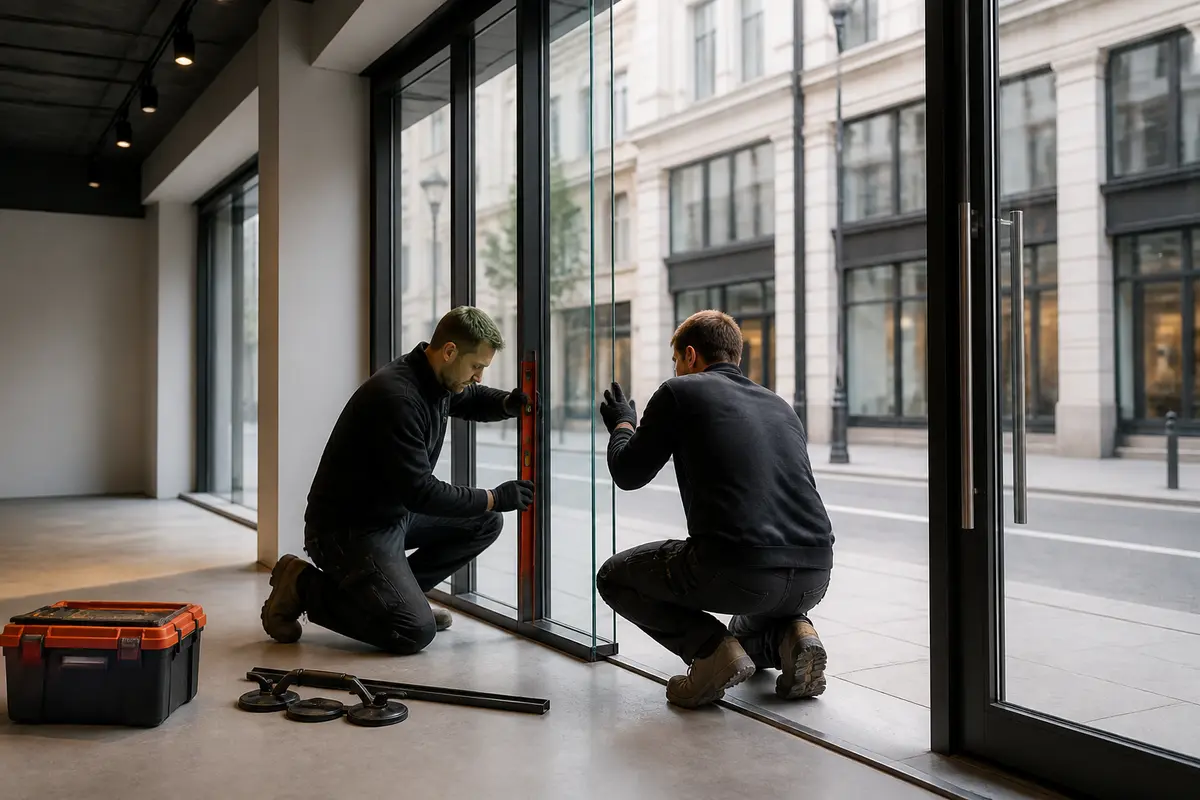
How to assess experience when comparing shopfront installers
Experience is best evaluated through relevant evidence and the quality of the conversation, not through one factor alone. A portfolio, length of trading or a single credential may be useful context, but none automatically proves that an installer is the right fit for your shopfront. Look for evidence that they understand the type of frontage, materials, access and scope you are discussing.
This proportionate approach is consistent with HSE guidance on assessing contractors, which advises that skills, knowledge, experience and training should suit the work’s complexity and risks. In practice, that supports asking for relevant references where appropriate, discussing how the work will be planned and appointing a contractor early enough for meaningful planning. It does not mean that any one document or membership guarantees a successful installation.
Questions that reveal whether an installer understands the job
The most productive questions are specific to your premises. As part of choosing reliable shopfront installers in London, ask prospective providers to address the following points clearly:
- What information do you need from a site survey before finalising the proposal?
- Have you considered comparable frontage, material or access requirements in the scope?
- Which dimensions, existing conditions or design details still need confirmation?
- What does the written scope include, and what is specifically excluded?
- What assumptions are being made about site readiness, access and timing?
- How will questions that arise during planning be communicated and recorded?
The answers do not need to be overly technical. What matters is whether they are relevant, understandable and honest about points that cannot be confirmed until the premises have been assessed.
Compare scope and communication, not just the quotation total
Shopfront installation costs should be compared alongside the scope on which they are based. Two totals may differ because one proposal includes different materials, preparation, access assumptions or other elements. Reading about how shopfront installation costs are calculated can make it easier to ask why figures differ without assuming that the lowest or highest price is automatically the better choice.
Set the written quotations side by side and compare the specification, inclusions, exclusions, assumptions and unresolved questions. Also consider the clarity of communication. If a provider cannot explain what the figure covers before work begins, it may be harder to compare the proposal fairly or manage later decisions.
When experience should carry more weight in your decision
Every shopfront project benefits from a clear assessment and a written scope. However, more detailed questioning is particularly sensible where the frontage is constrained, the design is bespoke, glazing or other material-specific fitting is involved, access is limited, or the work needs coordination around active business operations.
In these circumstances, experienced shopfront installers may be better placed to recognise the questions that need answering before plans are fixed. The appropriate weight to give experience remains proportionate: a straightforward replacement still deserves care, while a more involved requirement calls for stronger evidence that the installer has understood the relevant conditions.
A practical way to choose with confidence
A sound decision starts with the premises in front of you. Share accurate information, seek a site-specific scope, compare what each proposal actually includes and ask focused questions about materials, access, assumptions and timing. This makes professional shopfront installation easier to evaluate on substance rather than presentation alone.
If you are planning a London shopfront project, Direct Shopfront can help you begin the conversation around the actual frontage and requirements. When you are ready to discuss your proposed scope, you can contact Direct Shopfront with the available site and project details. The aim should be a clearer basis for deciding whether the proposed installer’s experience is relevant to the work you need done.
Contact Us
READY TO TRANSFORM YOUR SHOPFRONT?
Design - Installation - Materials
Tell us about your project and our team will help you plan the right design, materials and installation.
Request Quote
Free Estimates