
Shopfronts London Enhance Security Without Compromising Style
– Contact Us Today –
When it comes to commercial premises in one of the world’s most competitive urban environments, the facade of a business communicates far more than most owners realise. Shopfronts London serve as the front line of both brand identity and physical protection, creating a dual challenge that demands intelligent, experience-led solutions.
At Direct Shopfront, we understand that business owners should never have to choose between making their premises look remarkable and keeping them truly secure.
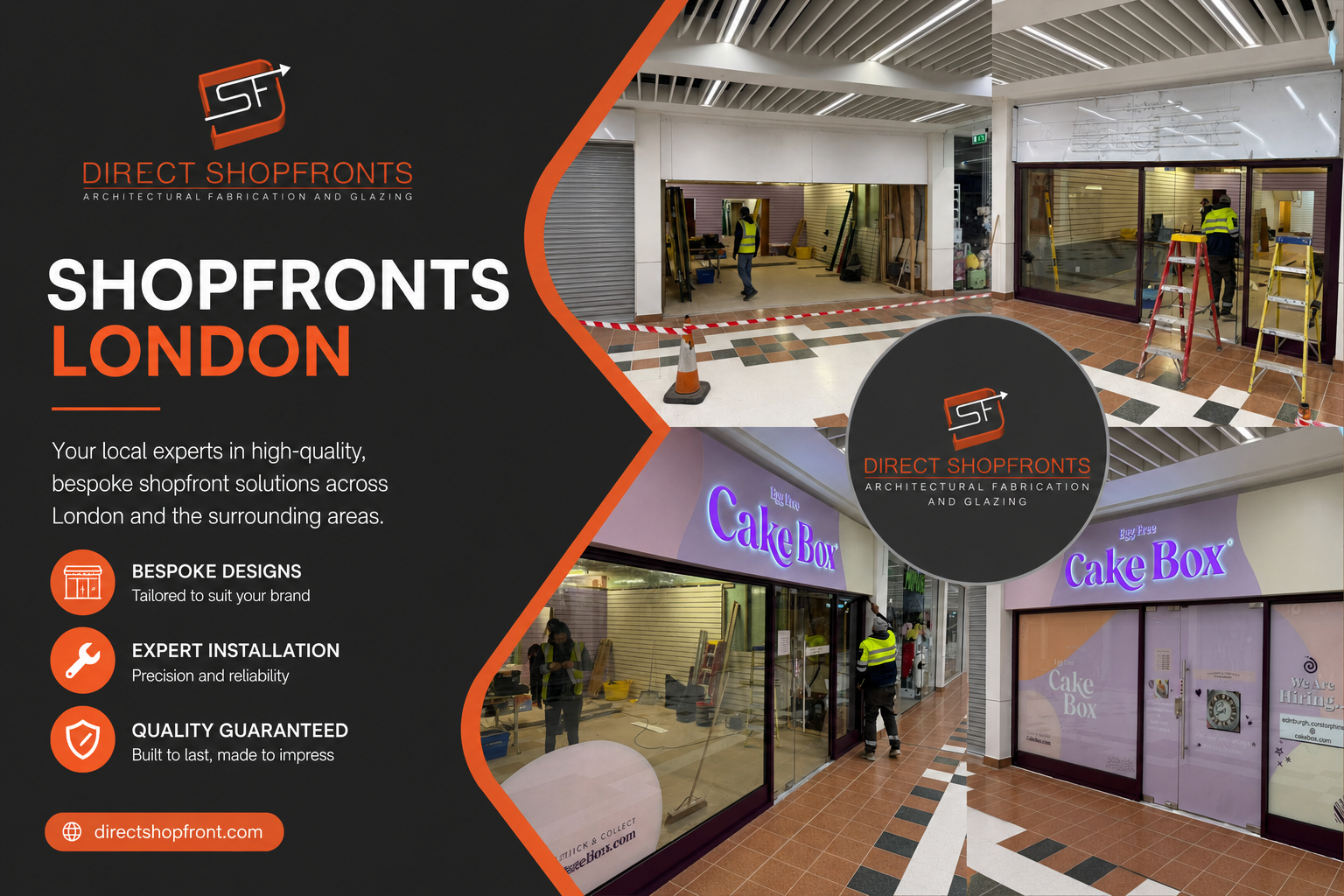
Protection Meets Presentation in Shopfronts London
Shopfronts London operate within a commercial landscape unlike any other city in the world. From the Victorian arcades of the West End to the glass-fronted studios of Shoreditch, every commercial unit tells a story. Yet beneath the visual narrative lies a pressing operational reality: retail crime, forced entry, and opportunistic vandalism are persistent concerns that cost UK businesses billions of pounds annually.
The old approach — installing heavy, ugly roller shutters and calling it done — is no longer acceptable. Today’s commercial premises demand solutions that work on multiple levels simultaneously: securing assets, satisfying landlord and planning authority requirements, projecting a professional image, and maximising the visual merchandising potential of every square inch of frontage.
1. Aluminium Shopfronts: The Architecture of Intelligent Security
Aluminium has become the material of choice for commercial fascia systems across London and for very good reason. It combines structural rigidity with design flexibility in ways that no other material can match.
Why Aluminium Leads on Both Security and Appearance
• Inherent strength:
Aluminium alloy profiles resist forced entry attempts that would compromise timber or UPVC equivalents. When properly fabricated, the frame itself becomes a structural deterrent.
• Corrosion resistance:
London’s damp, polluted urban atmosphere is notoriously harsh. Aluminium naturally resists oxidation, maintaining structural and visual integrity without regular maintenance.
• Powder coating options:
RAL colour matching allows precise brand colour alignment, meaning the security frame becomes a brand expression rather than an afterthought.
• Slim sightlines:
Modern aluminium systems achieve sightlines as narrow as 38mm, maximising glazed area without sacrificing frame integrity — critical for visual merchandising.
• Compatibility with high-security locking:
Unlike composite materials, aluminium profiles are engineered to accept multi-point locking mechanisms, shoot bolts, and security cylinders without structural compromise.
At Direct Shopfront, our aluminium fabrication is completed in-house, giving us full quality control over every profile, joint, and fixing point.
2. Security Glazing: Invisible Protection That Enhances Display
The glass in a commercial frontage is often perceived as its weakest point. However, advances in glazing technology have fundamentally transformed this assumption. Modern security glass does not look different from standard glazing — but its performance characteristics are in an entirely different category.
Types of Security Glass Used in Commercial Frontages
• Laminated safety glass:
Two or more glass panes bonded with a polyvinyl butyral (PVB) interlayer. When struck, the glass cracks but remains held in place by the interlayer, preventing instant access and reducing injury risk. Available up to EN 356 P6B standard.
• Toughened (tempered) glass:
Heat-treated to be four to five times stronger than standard annealed glass. On failure, it disintegrates into small, relatively harmless cubes rather than dangerous shards.
• Anti-bandit glazing:
Specifically engineered to resist repeated blows with hammers and axes. Preferred for high-risk locations such as off-licences, jewellers, and pharmacies.
• Manifestation films:
Applied to glazed surfaces to satisfy building regulations regarding vision panels, while simultaneously creating branded graphic displays. Security and compliance in one product.
• Solar control coatings:
Reduce UV transmission and heat build-up while maintaining clarity. Essential for west-facing units in summer, protecting displayed merchandise from fading without compromising visibility.
The key insight is that none of these glazing options require any visual compromise. From the outside, a unit fitted with anti-bandit glazing looks identical to one fitted with standard float glass. The protection is entirely invisible.
3. Roller Shutters That Don’t Ruin Your Retail Presence
The traditional perception of roller shutters as visually destructive has been comprehensively challenged by the evolution of perforated and vision shutter systems. These products allow business owners to close their premises securely at night while maintaining a degree of visual continuity with the daytime display.
Modern Shutter Options That Balance Security and Aesthetics
• Perforated aluminium shutters:
Small punched apertures in the slats allow ambient light through and permit limited visibility of window displays. Crime deterrence is maintained while the retail environment remains partially visible, supporting overnight merchandising.
• Vision shutters with polycarbonate strips:
Alternating aluminium and clear polycarbonate slats provide full visibility of window displays at night while still preventing physical access. Excellent for high-footfall evening locations.
• Built-in (inset) shutter boxes:
The shutter box is integrated within the fascia rather than bolted to the exterior. This is architecturally far superior and is particularly appropriate for listed buildings or conservation area units.
• Colour-matched powder coating:
Shutters finished in the same RAL colour as the main aluminium frame create a cohesive, designed appearance rather than the jarring contrast of unpainted galvanised steel.
• Grille-style shutters:
Open-weave metal grilles for lower-risk applications. Provide maximum nighttime visibility and an open, inviting appearance while physically securing the opening.
Direct Shopfront supplies and installs all shutter types across the capital, with particular expertise in conservation area compliance and listed building applications.
4. Access Control Integration: Smart Security for Modern Commercial Units
Physical barriers are only one element of a comprehensive commercial security strategy. Increasingly, London business owners are integrating electronic access control systems directly into their commercial fascia, creating seamless, intelligent entry management.
Access Control Features That Can Be Integrated into Frontage Systems
• Electromagnetic door locks:
Fitted within the door frame itself, these are invisible from the exterior and provide holding forces of up to 600kg — far beyond the capacity of any opportunistic attacker.
• Video intercom panels:
Surface-mounted intercom stations can be finished in brushed stainless steel or powder-coated aluminium to match the main frame, maintaining aesthetic consistency.
• Access card and fob readers:
Slim-profile readers can be recessed into pilasters or integrated into door furniture, eliminating the visual clutter of surface-mounted equipment.
• Keypad entry systems:
Backlit keypads in architectural finishes complement rather than compromise the frontage design. Modern units are rated to IP65, making them suitable for exposed external use.
• Automatic door operators:
Integrated within the door frame, these provide both convenience and controlled access. Particularly relevant for retail units with high footfall and compliance obligations under the Equality Act.
The integration of these systems at the design stage — rather than as a retrofit — is fundamental to achieving a result that looks intentional rather than improvised.
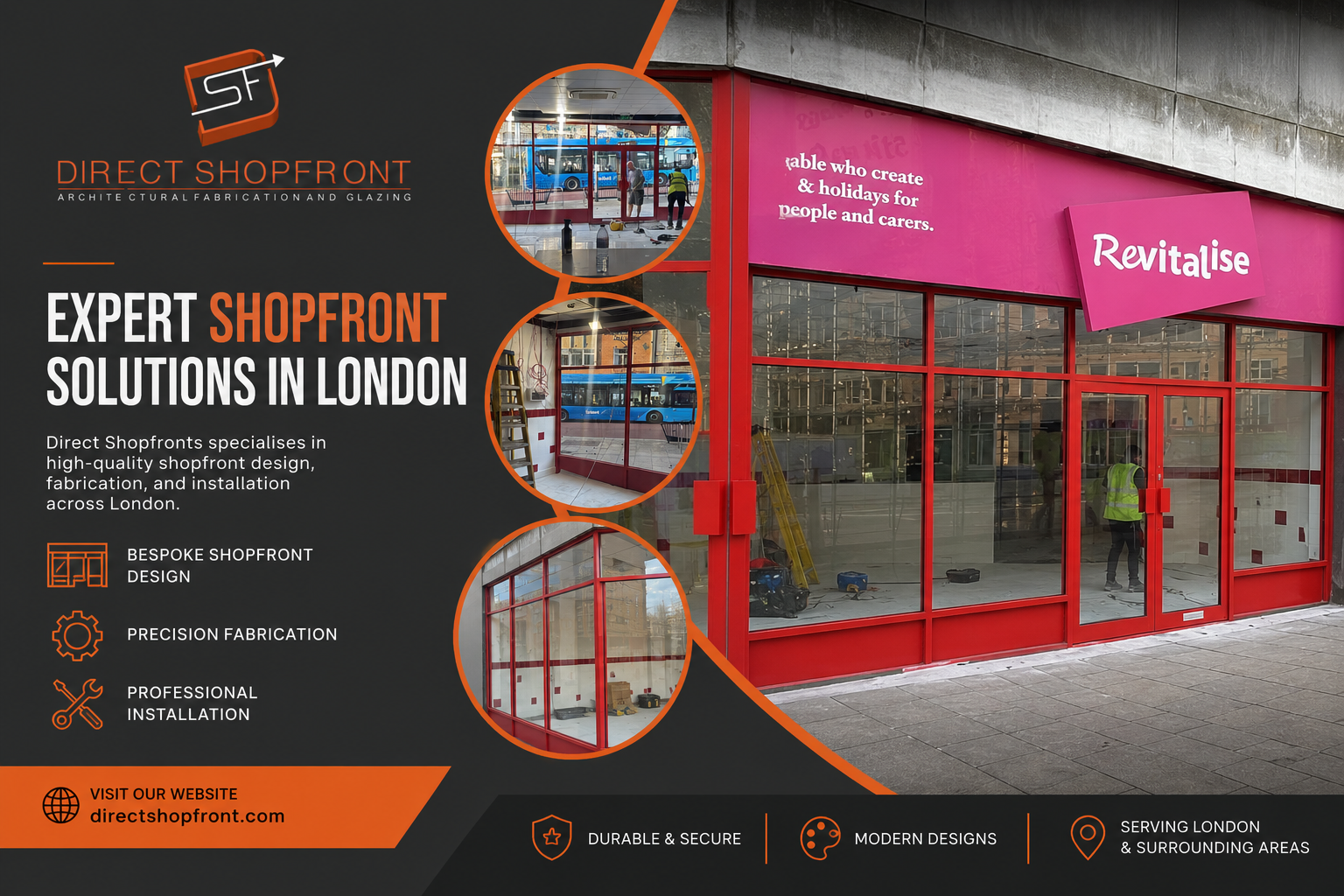
5. Planning Compliance and Conservation Area Considerations
London’s planning framework is among the most complex in the UK. A significant proportion of commercial units sit within conservation areas or are attached to listed buildings, creating constraints that must be navigated with knowledge and care. Security installations that do not account for these requirements can result in enforcement action, fines, and the cost of removal and replacement.
Navigating Planning Requirements for Commercial Frontages
• Conservation area consent:
Alterations to commercial frontages in conservation areas typically require prior approval from the local planning authority. The design of shutters, canopies, and signs must be sympathetic to the character of the area.
• Listed building consent:
Works to listed buildings require specific consent beyond standard planning permission. Materials, fixing methods, and reversibility are all subject to scrutiny.
• Shopfront design guides:
Most London boroughs publish supplementary planning documents giving detailed guidance on acceptable frontage materials, colours, and proportions. Direct Shopfront’s design team is familiar with borough-specific requirements across Greater London.
• Permitted development limits:
Certain minor works may be undertaken without formal consent, but the boundaries of permitted development for commercial properties are frequently misunderstood. Professional advice is essential.
• Building regulations:
Independently of planning, building regulations govern matters including structural stability, fire egress, and accessibility. A new commercial frontage must comply with all relevant parts of the Building Regulations.
Direct Shopfront provides a full planning support service, including pre-application advice, drawing preparation, and liaison with local planning authorities on behalf of clients.
6. Bespoke Canopies and Entrance Features: Security Through Design
The entrance to a commercial premises communicates status, intent, and permanence. A well-designed entrance canopy or vestibule does more than provide shelter — it creates a defined threshold that naturally controls pedestrian flow and reduces the casual anonymity that opportunistic crime depends upon.
How Entrance Architecture Contributes to Passive Security
• Canopy soffit lighting:
Integrated LED lighting in canopy soffits eliminates dark entry points — one of the primary environmental factors in opportunistic theft and antisocial behaviour. Illuminated entrances are demonstrably less targeted.
• Recessed entrance lobbies:
A stepped-back entrance creates a semi-enclosed space that is naturally monitored by passing pedestrians and overlooked from within the premises, increasing natural surveillance.
• Bollard integration:
Architectural bollards in matching materials can be integrated into the frontage design to prevent vehicle incursion — a growing concern for high street units and food service premises.
• CCTV housing integration:
Camera housings can be designed into canopy structures or fascia panels, ensuring CCTV coverage without the visual intrusion of surface-mounted equipment.
• Signage integration:
Illuminated signage within the canopy or fascia frame serves dual purpose: brand visibility at night and a lit environment that deters criminal activity.
7. The Direct Shopfront Design Process: Security-First, Aesthetic Always
At Direct Shopfront, we have developed a systematic design process that ensures security requirements are addressed from the very first stages of a project, rather than being retrofitted as an afterthought. This approach consistently produces superior results — both functionally and aesthetically.
Our Integrated Design Methodology
• Site security assessment:
Before any design work begins, we assess the specific security risk profile of the location — considering crime statistics, adjacent businesses, vehicular access, and existing physical measures.
• Planning research:
We identify all applicable planning constraints before preparing any drawings, ensuring that the proposed design is compliant from the outset rather than requiring revision.
• Material specification:
Security performance, maintenance requirements, planning compatibility, and brand alignment are all considered simultaneously in material selection.
• Technical detailing:
Our in-house draughtsmen produce detailed section drawings that show precisely how security elements integrate with the architectural design — eliminating site surprises.
• Installation supervision:
All installations are supervised by experienced site managers who understand both the technical requirements and the importance of site cleanliness and minimal disruption to trading.
Every Direct Shopfront installation is backed by a comprehensive aftercare package, ensuring that the security performance of your frontage is maintained throughout its service life.
Conclusion:
For London business owners, the stakes have never been higher. Competition for footfall is intense, planning scrutiny is rigorous, and crime remains a genuine operational risk. A frontage that fails on any of these dimensions is a liability. A frontage that excels across all of them is a genuine asset.
Direct Shopfront has been delivering exactly that combination across Greater London for years. Our team of designers, fabricators, and installation specialists work together under one roof to produce commercial frontages that protect your investment, reflect your brand, and meet every regulatory requirement — without compromise.
Frequently Asked Questions
1. Can security shutters be installed on listed buildings or conservation area properties in London?
Yes, but they require prior approval from the local planning authority. Inset shutter boxes finished in sympathetic materials and colours are typically the most accepted solution, as they minimise visual impact on the character of the building and surrounding area.
2. Do modern roller shutters affect the appearance of window displays at night?
Not necessarily. Perforated aluminium shutters and vision shutters with polycarbonate strips allow window displays to remain partially or fully visible after closing, supporting overnight merchandising while maintaining physical security.
3. What maintenance is required to keep an aluminium shopfront secure and looking its best?
Aluminium shopfronts require very little maintenance compared to timber or UPVC alternatives. A periodic clean with a mild detergent, an annual check of locking mechanisms and hinges, and occasional relubrication of moving parts is typically sufficient to maintain both appearance and security performance over many years.
4. Can access control systems be added to an existing shopfront without a full replacement?
In many cases, yes. Electromagnetic locks, keypad entry systems, and video intercom panels can be retrofitted into existing aluminium frames without requiring a complete replacement. However, a structural assessment of the existing frame is recommended first to confirm it can accommodate the additional hardware securely.
5. How do I choose between a full glass shopfront and a partially panelled design for my London premises?
The right choice depends on your business type, security risk profile, and planning constraints. Full glazed frontages maximise product visibility and natural light — ideal for retail and hospitality. Partially panelled designs offer greater structural rigidity and thermal performance, and are often more appropriate for offices, clinics, or premises in conservation areas where large expanses of glass may not be permitted.